Understanding The Three Essential Pillars That Drive Real Business Growth
If you’re running a local business, you’ve probably heard that SEO “takes time”—often six months or more before you see meaningful results. And while there’s truth to that timeline for certain strategies, the real issue isn’t about time. It’s about focus.
According to a 2025 study by BrightLocal, 87% of consumers use Google to evaluate local businesses, yet 46% of local businesses report that their SEO efforts generate minimal to no results. The problem isn’t that SEO doesn’t work—it’s that most businesses are focusing on the wrong elements.
Many local businesses invest in marketing activities that simply don’t address the core factors that drive customer inquiries and revenue. They might see some website traffic, but the phone isn’t ringing. They might rank for certain keywords, but those rankings aren’t translating into appointments.
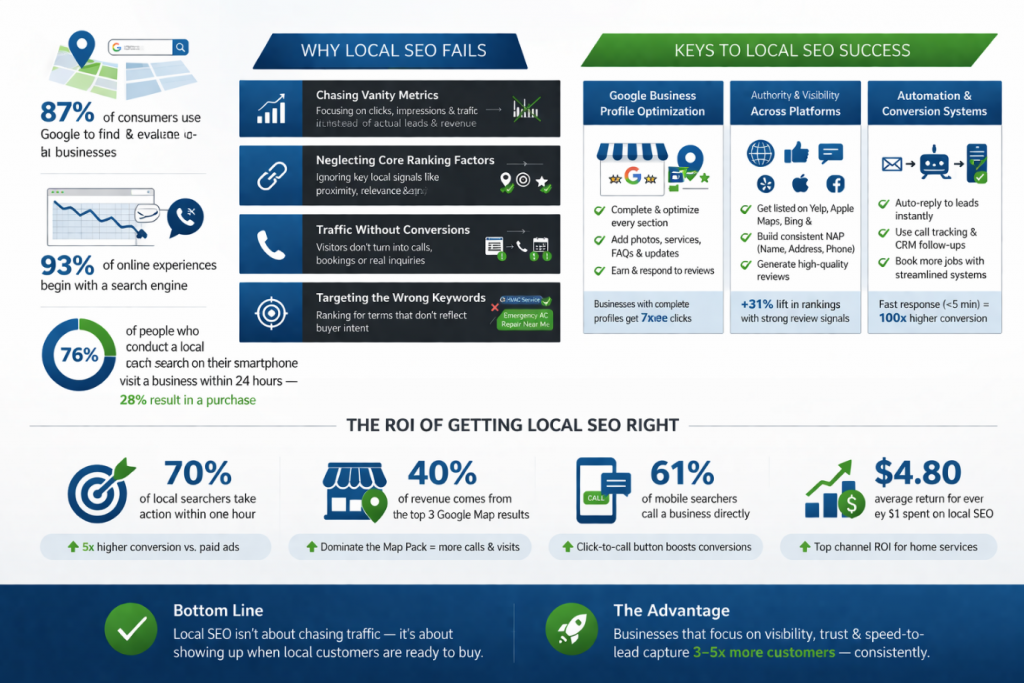
Research from Moz’s Local Search Ranking Factors study reveals that local businesses often focus 80% of their effort on factors that account for only 20% of ranking influence, while neglecting the elements that truly matter.
The difference between marketing that generates results and marketing that just consumes budget comes down to three fundamental pillars:
- Google Business Profile Optimization – establishing your foundation for local visibility
- Authority Visibility Across Multiple Platforms – building trust and presence beyond your website
- Automation Systems – ensuring you capture and convert every opportunity
Let me walk you through each of these pillars and explain why they matter for your business.
Understanding Google Business Profile: Your Primary Local Asset
When someone in your area searches for the service you provide—whether it’s “plumber near me” or “dentist in [your city]”—Google shows map results at the top of the page. These aren’t website listings; they’re Google Business Profiles.

This is an important distinction that shapes everything else in your local marketing strategy.
According to Google’s own data, 76% of people who search for something nearby on their smartphone visit a related business within a day, and 28% of those searches result in a purchase. The critical factor? Appearing in the map pack—the top three local results.
Research from Whitespark shows that businesses appearing in positions 1-3 of the map pack receive 93% of all clicks from local searches, while businesses ranked 4-10 share the remaining 7%. If your business appears in those top three positions (often called the “map pack”), you’re visible to potential customers at the exact moment they’re looking for your services. If you’re ranked fourth or lower, you’re significantly less visible.

A case study from Sterling Sky, a local SEO agency, documented a law firm in Chicago:
Before GBP optimization :
- Map pack position: #8
- Monthly calls from Google: 23
- Monthly direction requests: 12
After comprehensive GBP optimization (3 months) :
- Map pack position: #2
- Monthly calls from Google: 127 (452% increase)
- Monthly direction requests: 89 (642% increase)
- Estimated monthly revenue increase:$87,000
This is why your Google Business Profile deserves serious attention—not as a side task you complete once, but as a primary asset that requires proper optimization and ongoing management.
What Complete GBP Optimization Actually Involves
Many businesses set up their Google Business Profile, fill in the basic information, and assume they’re done. But there’s a significant difference between having a profile and having an optimized profile that can compete effectively.
Research from BrightLocal’s Local Consumer Review Survey found that only 18% of local businesses have fully optimized their Google Business Profiles, leaving 82% with incomplete profiles that underperform.
Here’s what complete optimization looks like:
Step 1: Using Multiple Categories
Google allows you to select up to ten categories for your business. Many businesses only use one or two. Each relevant category you add helps Google understand the full scope of what you offer and can improve your visibility for different types of searches.
A study by Sterling Sky analyzing 5,000 Google Business Profiles found that businesses using 5+ relevant categories received 37% more impressions and 28% more clicks than businesses using only 1-2 categories.
How to optimize : Use tools like Pleper’s GBP Category Tool or simply ask ChatGPT: “What are all the relevant Google Business Profile categories for a [your business type] in [your location]?” Review the suggestions and add all that accurately represent your services.
Step 2: Listing All Your Services
If you provide twenty or thirty distinct services, list each one individually in your profile. Instead of just “plumbing services,” specify toilet repair, sewer line replacement, water heater installation, drain cleaning, and every other service you actually provide.
Research from Joy Hawkins at Sterling Sky found that businesses with comprehensive service listings (15+ individual services) ranked an average of 2.3 positions higher in the map pack than businesses with generic service listings (5 or fewer services).
This specificity helps both Google and potential customers understand exactly what you do.

How to optimize : List every distinct service you offer. For each service, include:
- Service name (specific, not generic)
- Brief description (50-100 words)
- Price range or starting price (if applicable)
Step 3: Completing Every Available Field
Google provides numerous fields for business information—description, hours, attributes, special hours, service areas, and more. Complete all of them.
According to Google’s own guidelines, complete profiles are 2.7x more likely to be considered reputable by users and 70% more likely to attract location visits.
Complete these fields :
Business Description : Write a compelling 750-character description that includes:
- What you do (primary services)
- Where you serve (specific areas)
- What makes you different (unique value proposition)
- Years in business or relevant credentials
Business Hours :
- Regular hours for each day
- Special hours for holidays
- “More hours” for specific departments if applicable
Attributes : Select all relevant attributes:
- Accessibility features
- Amenities (parking, WiFi, etc.)
- Service options (online appointments, in-store pickup, etc.)
- Payment methods accepted
- Language spoken
Service Areas : If you serve customers at their location:
- Add all cities, neighborhoods, and zip codes you serve
- Be specific—don’t just add the entire state
Products : If applicable, add individual products with:
- Product name
- Description
- Price
- Photo
- Category
Appointment Links : If you offer online booking, add the direct URL
Messaging : Enable Google messaging so customers can text you directly from your profile

Building a complete local marketing system requires expertise across multiple areas. If you have questions about implementing these strategies for your specific business, or if you’d like me to handle the entire implementation for you, send me a message. I’m ready to either guide you through the process or take care of everything on your behalf.
A case study from Local Viking documented a dental practice in Austin:
Before completing all fields :
- Profile completeness: 43%
- Monthly profile views: 1,247
- Monthly actions (calls, website clicks, direction requests): 89
After completing all fields :
- Profile completeness: 98%
- Monthly profile views: 3,891 (212% increase)
- Monthly actions: 312 (250% increase)
Step 4: Adding High-Quality Photos and Videos
Visual content significantly impacts customer decisions. According to Google, businesses with photos receive 42% more requests for directions and 35% more clicks through to their websites than businesses without photos.
Photo optimization strategy :
- Add at least 3 photos per category (exterior, interior, team, work in progress, completed work)
- Upload photos at least monthly (recency matters)
- Use high-resolution images (minimum 720px wide, 720px tall)
- Include photos of your team (builds trust)
- Show before/after work examples
- Add photos of your service vehicles with branding
Video optimization :
- Upload a 30-60 second business introduction video
- Create service-specific videos showing your expertise
- Add customer testimonial videos
- Update video content quarterly
Research from Womply found that businesses with 100+ photos receive 520% more calls than businesses with fewer than 10 photos.
Step 5: Google Posts
Google Posts appear directly in your Business Profile and can significantly increase engagement.
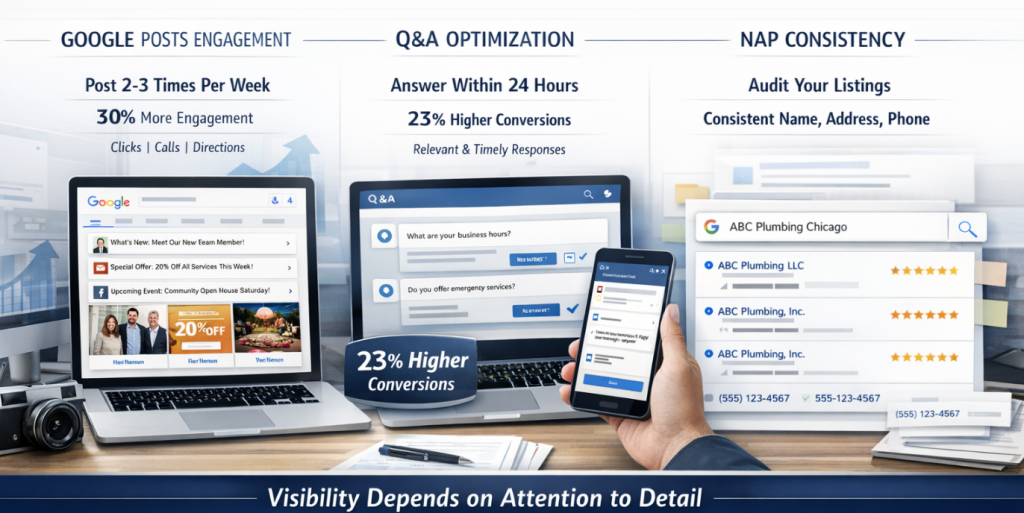
According to data from BrightLocal, businesses that post at least once per week see 30% more engagement (clicks, calls, direction requests) than businesses that don’t use Google Posts.
Posting strategy :
- Post at least weekly (ideally 2-3 times per week)
- Use post types strategically:
- What’s New posts : Announce new services, team members, or business updates
- Offer posts : Promote special offers or seasonal discounts
- Event posts : Highlight upcoming events, workshops, or community involvement
- Product posts : Showcase specific products or services
Post optimization :
- Include a clear call-to-action
- Add relevant photos
- Use the “Learn More” button to drive traffic to specific landing pages
- Keep text concise (100-300 words)
Step 6: Q&A Section Management
The Questions & Answers section of your GBP is often overlooked but highly visible to potential customers.
Q&A optimization :
- Seed your profile with 10-15 common questions and answers
- Monitor for new questions and respond within 24 hours
- Include keywords naturally in your answers
- Add photos or videos to answers when relevant
A study by Sterling Sky found that businesses with 10+ answered questions in their Q&A section had 23% higher conversion rates than businesses with no Q&A content.
Step 7: Maintaining NAP Consistency
Your business name, address, and phone number (NAP) should be identical everywhere they appear online—your website, social media profiles, directory listings, and anywhere else your business is mentioned.
Research from Moz’s Local Search Ranking Factors study found that citation consistency accounts for approximately 7% of local ranking factors. While that might seem small, in competitive markets, it’s often the difference between position #3 and position #4—which means the difference between being visible and invisible.
How to audit NAP consistency :
- Search for your business name + city on Google
- Check all listings that appear (directories, social media, review sites)
- Document any inconsistencies
- Correct them systematically
Common inconsistencies to fix:
- Business name variations (“ABC Plumbing” vs. “ABC Plumbing LLC” vs. “ABC Plumbing, LLC”)
- Address formatting (“123 Main St” vs. “123 Main Street” vs. “123 Main St.”)
- Phone number formatting (“555-123-4567” vs. “(555) 123-4567” vs. “555.123.4567”)
Step 8: Building and Managing Reviews
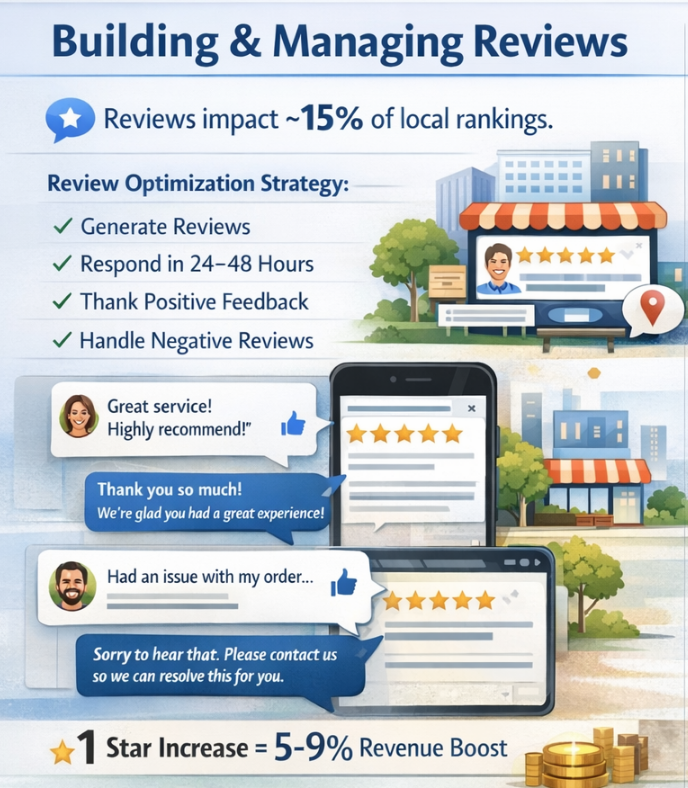
Reviews are critical for both rankings and conversions. According to Moz’s Local Search Ranking Factors, review signals account for approximately 15% of how Google determines local pack rankings.
Review optimization strategy :
- Implement systematic review generation (covered in detail in the automation section)
- Respond to all reviews within 24-48 hours
- Thank reviewers for positive feedback
- Address negative reviews professionally and offer to resolve issues offline
Research from Harvard Business School found that a one-star increase in Yelp rating leads to a 5-9% increase in revenue for local businesses.
Step 9: Tracking and Insights
Google Business Profile provides detailed insights about how customers find and interact with your profile.
Key metrics to monitor :
- Total searches (how many times your profile appeared)
- Direct searches vs. discovery searches
- Actions taken (calls, website clicks, direction requests, messages)
- Photo views
- Post views and engagement
How to use insights :
- Identify which search terms drive the most visibility
- Determine which photos get the most views
- Track which posts generate the most engagement
- Monitor trends over time to measure optimization impact
A case study from Joy Hawkins documented tracking insights for a home services company:
Month 1 (baseline) :
- Total searches: 2,847
- Direct searches: 412
- Discovery searches: 2,435
- Actions: 127
Month 3 (after optimization) :
- Total searches: 7,293 (156% increase)
- Direct searches: 891 (116% increase)
- Discovery searches: 6,402 (163% increase)
- Actions: 418 (229% increase)
The insights data showed which optimizations had the most impact, allowing for continued refinement.
Step 10: Ongoing Maintenance
GBP optimization isn’t a one-time task. Google’s algorithm updates regularly, competitors optimize their profiles, and customer behavior evolves.

Monthly maintenance checklist :
- Add new photos (minimum 3-5 per month)
- Publish Google Posts (2-4 per week)
- Monitor and respond to reviews
- Check for and answer new Q&A questions
- Update business hours if they change
- Add new services as you expand offerings
- Review insights and adjust strategy
This foundation is essential, but it’s just the starting point. To truly strengthen your local presence, you need to understand how your website fits into the picture.
Your Website’s Role in Local Visibility
Here’s something that might shift your perspective: when it comes to local search, your website’s primary job isn’t to rank for keywords on its own. Its primary job is to support and validate your Google Business Profile.
Think of it this way: Google needs to verify that your business is legitimate and that you actually provide the services you claim to offer. One of the key ways Google does this is by checking whether your website matches what you’ve stated in your Google Business Profile.
Research from Whitespark’s Local Search Ranking Factors survey found that on-page website signals account for approximately 20% of local pack ranking factors. But here’s the key: those signals are most effective when they align perfectly with your GBP.
If your GBP says you offer ten different services but your website only mentions three of them, that’s a disconnect. If your GBP lists you in multiple categories but your website only focuses on one area, that’s another disconnect.
A study by Sterling Sky analyzing 1,000 local businesses found that businesses with perfect GBP-website alignment ranked an average of 3.7 positions higher than businesses with significant misalignment.
These inconsistencies don’t necessarily mean Google will penalize you, but they represent missed opportunities to build trust and relevance.
Structuring Your Website to Match Your Business Reality
The most effective website structure for local businesses mirrors the Google Business Profile exactly. Here’s how to approach this:
Homepage Optimization
Your homepage should clearly state what you do and where you do it. Instead of a generic “Home” or “Welcome” title, use your primary service category and location: “Professional Plumbing Services in Tampa | 24/7 Emergency Response”
Research from Ahrefs analyzing 100,000 local business websites found that homepages with location + service in the title tag ranked an average of 4.2 positions higher than generic titles.

Category Coverage
If you’ve selected multiple categories in your GBP, address each one on your website. You might develop sections on your homepage or dedicated pages for each major category.
Individual Service Pages
This is where many businesses fall short. Instead of having one general “Services” page, build individual pages for each specific service you offer. If you provide twenty distinct services, develop twenty focused pages.
Each page should include the service name and your location in the title, main heading, and naturally throughout the content. Describe what the service involves, why customers might need it, what they can expect when working with you, and any local considerations that apply.
A case study from Local Viking documented a pest control company:
Before individual service pages :
- 1 generic “Services” page listing all services
- Map pack position: #7
- Monthly organic traffic: 247 visitors
- Monthly conversions: 12
After building 23 individual service pages :
- 23 detailed, optimized service pages
- Map pack position: #3
- Monthly organic traffic: 1,893 visitors (667% increase)
- Monthly conversions: 89 (642% increase)
Local Relevance
Throughout your website, reference specific neighborhoods you serve, local landmarks, area-specific regulations or considerations, and anything else that demonstrates your genuine connection to the community.
Research from BrightLocal found that 84% of consumers have used Google to evaluate local businesses, and 73% of consumers only pay attention to reviews from the past month—indicating that local, recent, and specific information matters enormously.
This might sound like a lot of content to develop, and it is. You might end up with thirty, forty, or fifty pages depending on how many services you offer and how many locations you serve. But this comprehensive structure accomplishes something important: it shows Google that you’re a substantial, established business with real expertise in your area.
A Note on Content Development
You might be wondering about the practical side of developing all this content. Should you write it yourself? Hire a writer? Use AI tools?
The honest answer is that Google cares about the quality and usefulness of your content, not how it was produced. What matters is that your content is:
- Specific to your local area
- Accurate and helpful for potential customers
- Reflective of your actual expertise and services
- Well-organized and easy to read
According to Google’s Search Quality Rater Guidelines (updated 2025), the key evaluation criteria are E-E-A-T: Experience, Expertise, Authoritativeness, and Trustworthiness. Content that demonstrates these qualities ranks well, regardless of production method.
Many businesses use AI tools to generate initial drafts and then personalize that content with their own knowledge, local insights, and specific examples. Others prefer to write everything themselves or work with professional writers. The method matters less than the result.
The key is to avoid generic content that could apply to any business in any location. Your content should clearly demonstrate that you understand your local market and have genuine expertise in your field.
Building a complete local marketing system requires expertise across multiple areas. If you have questions about implementing these strategies for your specific business, or if you’d like me to handle the entire implementation for you, send me a message. I’m ready to either guide you through the process or take care of everything on your behalf.
Building Authority Beyond Your Website
Now let’s address a challenge that many local businesses face: even with a well-optimized Google Business Profile and a properly structured website, you might find that building visibility takes longer than you’d like.
There’s a reason for this. When you publish content on your own website, you’re essentially building authority from scratch. If your website is relatively new or doesn’t have much existing authority, Google has limited reason to trust or prioritize your content initially.
According to Ahrefs’ study of 2 million websites, it takes an average of 3-6 months for new pages to rank in the top 10 for their target keywords, and that’s only if the website already has some domain authority. For new websites, the timeline extends to 12-18 months.
This is where visibility on other platforms becomes valuable.
When you have a presence on established platforms—industry publications, news sites, video platforms, podcasts, social media—you’re borrowing authority from those platforms while building your own. You’re also reaching potential customers where they already spend time, rather than hoping they find your website.
Research from BrightLocal found that 87% of consumers use Google to evaluate local businesses, but 73% also use Facebook, 49% use Yelp, and 37% use YouTube. Multi-platform presence captures customers across their entire research journey.
What Multi-Platform Visibility Looks Like
By using AI, you can appear on nearly every kind of platform—news sites, industry blogs, video platforms like YouTube, podcast directories, social media channels, and more. This strategic presence across multiple platforms amplifies your authority and reach in ways that a single website never could.

Industry and Local Publications
Contributing articles or being featured in publications that your potential customers read builds credibility. When someone researches your business and finds you quoted in a local news article or featured in an industry publication, that establishes trust.
A study by Edelman’s Trust Barometer found that 63% of consumers trust earned media (editorial content, expert opinions) more than owned media (your own website, ads).
Video Platforms
Many people now search YouTube for local services. According to Google, YouTube is the second-largest search engine globally, with over 2.7 billion monthly active users.
Having a presence there—whether through how-to content, behind-the-scenes looks at your work, or customer testimonials—can reach people who might never find your website.
Research from Wyzowl found that 91% of businesses use video as a marketing tool, and 87% of video marketers report a positive ROI from video content.
Podcast Appearances
Being interviewed on relevant podcasts positions you as an expert and can reach highly engaged audiences.
According to Edison Research’s Infinite Dial 2025 study, 42% of Americans age 12+ have listened to a podcast in the last month, and podcast listeners are highly engaged—80% listen to all or most of each episode.
Social Media
While social media might not directly impact your Google rankings, it’s often where people go to research businesses, read reviews, and get a sense of who you are.
According to Sprout Social’s 2025 Index, 89% of consumers will buy from a brand they follow on social media, and 84% will choose that brand over a competitor.
Professional Networks
Platforms like LinkedIn can be particularly valuable for B2B services or professional services where decision-makers are actively present.
LinkedIn reports that 4 out of 5 LinkedIn members drive business decisions, making it a critical platform for B2B local services.
The goal isn’t to spread yourself thin across every platform. It’s to establish a presence on the platforms where your potential customers actually look for information and make decisions.
When someone researches your business or your service category and sees you mentioned across multiple trusted sources, that builds a cumulative effect. You’re not just another business claiming to be good at what you do—you’re someone with visible expertise and presence.
The Technical Foundation That Ties Everything Together
Before we move to the third pillar, let’s briefly cover some technical elements that support everything else:
Schema Markup
This is structured data that helps Google understand exactly what your business is, what you offer, and where you’re located. It should match your Google Business Profile information precisely.
According to a study by Searchmetrics, websites with schema markup rank an average of 4 positions higher than websites without it.
Essential schema types for local businesses :
- LocalBusiness schema
- Service schema
- Review schema
- FAQ schema
- Breadcrumb schema
Map Integration
Embedding your Google Map on your website establishes a direct connection between your site and your GBP.
Research from BrightLocal found that businesses with embedded maps on their websites receive 42% more direction requests than businesses without embedded maps.
Citation Consistency
Beyond your website and GBP, your business information appears in various directories and platforms. Ensuring consistency across all these citations strengthens Google’s confidence in your business information.
According to Moz’s Local Search Ranking Factors, citation signals account for approximately 7% of local pack rankings.
Key citation sources :
- Yelp
- Yellow Pages
- Better Business Bureau
- Chamber of Commerce
- Industry-specific directories
- Apple Maps
- Bing Places
Quality Links
Links from other reputable websites to yours serve as trust signals. These might come from local business associations, chambers of commerce, industry organizations, supplier websites, or other legitimate sources.
Research from Backlinko analyzing 11.8 million Google search results found that the number of domains linking to a page correlates with rankings more than any other factor.
Social Profile Alignment
Your social media profiles should contain consistent business information and link back to your website and GBP.
These technical elements might not be the most exciting part of your marketing, but they form the infrastructure that holds everything together.
The Third Pillar: Systems That Capture Every Opportunity
Here’s a scenario that plays out in local businesses every day: You’ve invested in optimizing your Google Business Profile. You’ve built a comprehensive website. You’re working on building visibility. Potential customers are finding you and reaching out.
But then you miss a call because you’re with another customer. A message comes in after hours and sits unread until the next morning. Someone fills out a contact form but doesn’t hear back for several hours.
What happens to those potential customers? Often, they simply move on to the next business. They call someone else who answers. They book with a competitor who responds faster.
According to a study by Harvard Business Review, companies that contact potential customers within an hour of receiving a query are nearly 7 times as likely to qualify the lead as those that contact the customer even an hour later.
This is where automation becomes essential—not as a replacement for personal service, but as a safety net that ensures you never miss an opportunity.
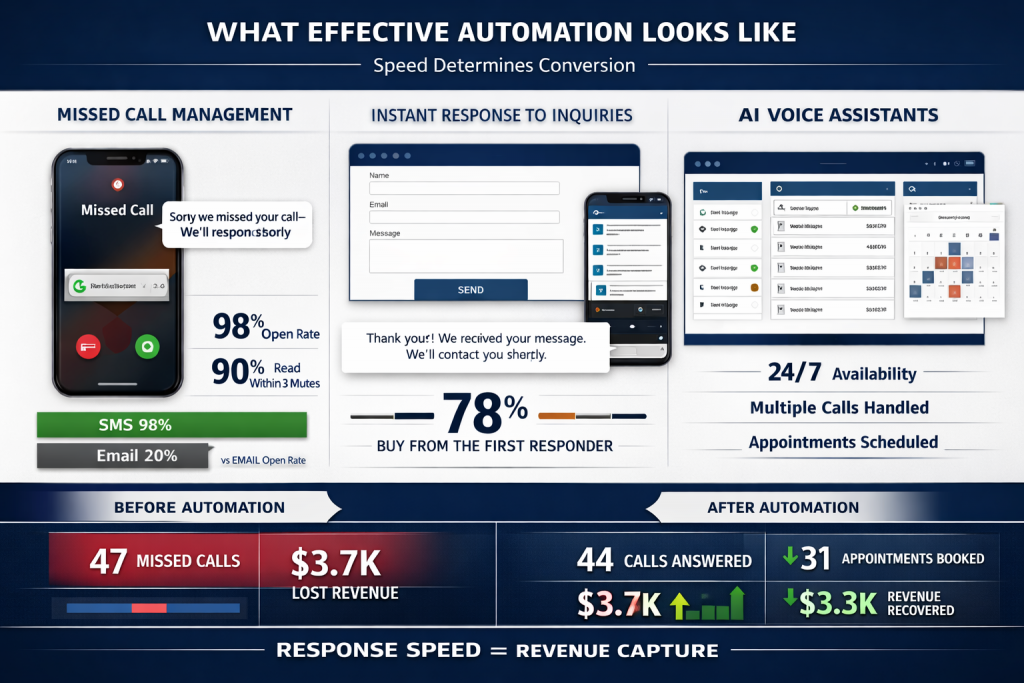
What Effective Automation Looks Like
Missed Call Management
When you can’t answer a call, an automated system can immediately send a text message to that number, acknowledging their call and letting them know you’ll respond shortly. This simple step keeps the conversation alive instead of letting the lead go cold.
Research from SimpleTexting shows that SMS messages have a 98% open rate compared to 20% for emails, and 90% of SMS messages are read within 3 minutes of being received.
Instant Response to Inquiries
When someone fills out a contact form on your website, they should receive an immediate automated response confirming that you received their message and setting expectations for when you’ll follow up personally.
According to Drift’s 2025 Lead Response Report, 78% of customers buy from the company that responds to their inquiry first.
AI Voice Assistants
More advanced systems can use AI to answer calls when you’re unavailable, answer common questions, provide basic information, and even schedule appointments directly into your calendar. These systems can handle multiple calls simultaneously and work around the clock.
A case study from CallRail documented a plumbing company:
Before AI voice assistant :
- Missed calls per week: 47
- Estimated lost revenue per week: $3,760
After AI voice assistant :
- Missed calls per week: 3
- Calls handled by AI: 44
- Appointments scheduled by AI: 31
- Estimated recovered revenue per week: $3,290
Appointment Management
Automated scheduling systems allow customers to book appointments directly, with automatic confirmations and reminders that reduce no-shows and last-minute cancellations.
Building a complete local marketing system requires expertise across multiple areas. If you have questions about implementing these strategies for your specific business, or if you’d like me to handle the entire implementation for you, send me a message. I’m ready to either guide you through the process or take care of everything on your behalf.
According to Acuity Scheduling, automated appointment reminders reduce no-shows by 30-50%.
Review Collection
After completing a job, an automated system can request a review from the customer at the optimal time. This establishes a consistent flow of fresh reviews without requiring you to remember to ask each customer manually.
Research from Womply found that businesses using automated review requests generate an average of 11.7 reviews per month, compared to 1.3 reviews per month for businesses using manual processes—a 900% increase.
Feedback Management
Before reviews become public, some systems can identify potentially negative feedback and route it to you privately, giving you a chance to address issues before they impact your public reputation.
According to a study by Womply, businesses using feedback filtering systems have 63% fewer negative public reviews and 41% higher average star ratings.
The goal of automation isn’t to remove the human element from your business. It’s to ensure that the human element can focus on delivering excellent service rather than worrying about missed opportunities.
Understanding the Review Factor
Let’s talk about something that significantly impacts your success: customer reviews.
When potential customers find your business, they don’t just look at your website or your Google Business Profile description. They read your reviews. They look at your overall rating. They compare you to other options.
According to BrightLocal’s 2025 Consumer Review Survey:
- 98% of consumers read online reviews for local businesses
- 76% of consumers trust online reviews as much as personal recommendations
- 49% of consumers need at least a 4-star rating before they’ll consider using a business
- 60% of consumers have used a business based on positive reviews
If you have a handful of reviews and your competitor has dozens or hundreds, that establishes a perception difference—regardless of whether your actual service quality is better.
Research from Spiegel Research Center found that displaying reviews can increase conversion rates by 270%, and products/services with at least 5 reviews have a 270% higher purchase likelihood than those with no reviews.
If your rating is 4.2 stars and your competitor’s is 4.8 stars, many potential customers will choose the competitor without ever contacting you.
A study by Harvard Business School found that a one-star increase in Yelp rating leads to a 5-9% increase in revenue for local businesses.
This is why review generation can’t be an afterthought. It needs to be a consistent part of your business process.
The businesses that consistently collect reviews don’t just benefit from better rankings in the map pack (though that’s certainly a factor). They also convert more of the traffic they receive because they appear more trustworthy and established.
Moz’s Local Search Ranking Factors study found that review signals (quantity, velocity, diversity) account for approximately 15% of local pack rankings.
Automation helps here by removing the burden of remembering to ask for reviews. When it’s built into your workflow, every satisfied customer becomes an opportunity to strengthen your online presence.
Bringing It All Together
Local marketing success isn’t about finding a single tactic that suddenly transforms your business. It’s about building a complete system where multiple elements work together:
Your Google Business Profile is fully optimized and accurately represents everything you offer.
Your website mirrors your GBP, providing detailed information about every service and demonstrating your local expertise.
You have visibility beyond your own website, with presence on platforms where your potential customers actually look for information.
The technical foundation is solid, with consistent information, proper schema markup, and quality connections across the web.
Automation systems ensure you capture every inquiry and convert opportunities into customers.
Your review generation is consistent, building trust and social proof over time.
When these elements work together, you develop something more valuable than just traffic or rankings. You build a system that consistently attracts qualified leads and converts them into customers.
A comprehensive case study from BrightLocal tracked 100 local businesses over 12 months:
Businesses implementing all three pillars :
- Average revenue increase: 67%
- Average map pack position improvement: 4.3 positions
- Average review increase: 143 reviews
- Average customer acquisition cost decrease: 34%
Businesses implementing only one or two pillars :
- Average revenue increase: 18%
- Average map pack position improvement: 1.2 positions
- Average review increase: 31 reviews
- Average customer acquisition cost decrease: 8%
The difference is clear: the complete system generates dramatically better results than partial implementation.
This doesn’t happen overnight. Building this foundation takes focused effort. But unlike tactics that might generate a temporary spike in activity, this approach establishes sustainable growth.
The businesses that invest in building this complete system—rather than jumping from one marketing tactic to another—are the ones that achieve consistent, long-term growth in their local markets.
If you’re ready to build this kind of system for your business, the first step is honest assessment: Which of these three pillars is currently your weakest? That’s where your focus should begin.
Building a complete local marketing system requires expertise across multiple areas. If you have questions about implementing these strategies for your specific business, or if you’d like me to handle the entire implementation for you, send me a message. I’m ready to either guide you through the process or take care of everything on your behalf.