Understanding the fundamental shift in how Google and AI platforms evaluate authority
If you’ve invested in SEO over the past couple of years, you may have noticed something concerning: even with optimized content, proper keywords, and technical improvements, your rankings might have dropped. Or perhaps you’re ranking well, but traffic has declined. Or traffic is stable, but conversions have fallen.
You’re not alone. According to recent data, 44% of websites reported significant ranking losses after Google’s Helpful Content and Core Updates in 2023-2025. But the issue goes deeper than algorithm updates. The entire foundation of how search engines and AI platforms evaluate websites has fundamentally changed.
Let me explain what’s happening and, more importantly, what’s actually working now.
The Authority Shift: Why “Good Content” Isn’t Enough Anymore
For years, SEO followed a relatively predictable formula: research keywords, optimize on-page elements, build backlinks, publish quality content, and wait for rankings to improve.
That model is broken.

Google’s E-E-A-T algorithm (Experience, Expertise, Authoritativeness, Trustworthiness) has shifted the focus from what you publish to who is publishing it. The search engine now prioritizes established authority over content optimization.
This means a perfectly optimized article on your website can lose to a less-optimized piece on a high-authority site—simply because Google trusts the source more.
For local businesses and smaller websites without existing brand recognition, this presents a significant challenge. You can have excellent content, proper technical SEO, and even quality backlinks, but if Google doesn’t recognize your site as an authoritative source, your visibility will be limited.
The Data Behind the Shift
Recent Google updates have hit low-authority sites particularly hard. Even high-quality content loses rankings if it isn’t supported by credible brand signals—such as media mentions, citations, or high-authority backlinks.
In essence, Google now asks: “Who’s behind this content?” rather than simply “Is this content good?”
This isn’t just about rankings anymore. It’s about whether your business gets discovered at all.
The AI Factor: A New Layer of Complexity
The challenge extends beyond Google. AI platforms like ChatGPT, Gemini, Perplexity, and Google’s AI Overviews are changing how people find information and make decisions.
Consider this: when someone asks ChatGPT or Perplexity for a recommendation in your industry, these systems don’t crawl your website in real-time. They reference sources they already trust—established publications, recognized brands, and authoritative platforms.
If your business isn’t mentioned on these trusted sources, AI systems won’t recommend you. It’s that simple.

Research shows that approximately 90% of AI platform citations favor high-authority sites and recognized brands. Small business websites, regardless of content quality, rarely make it into AI-generated recommendations.
This represents a fundamental shift in how potential customers discover businesses:
Traditional search : User searches → sees your website in results → visits your site → evaluates your content
AI-powered search : User asks AI → AI references trusted sources → recommends businesses mentioned by those sources → user contacts recommended businesses
If you’re not referenced by trusted sources, you’re invisible in this new discovery model.
The Surprising Truth About NoFollow Links
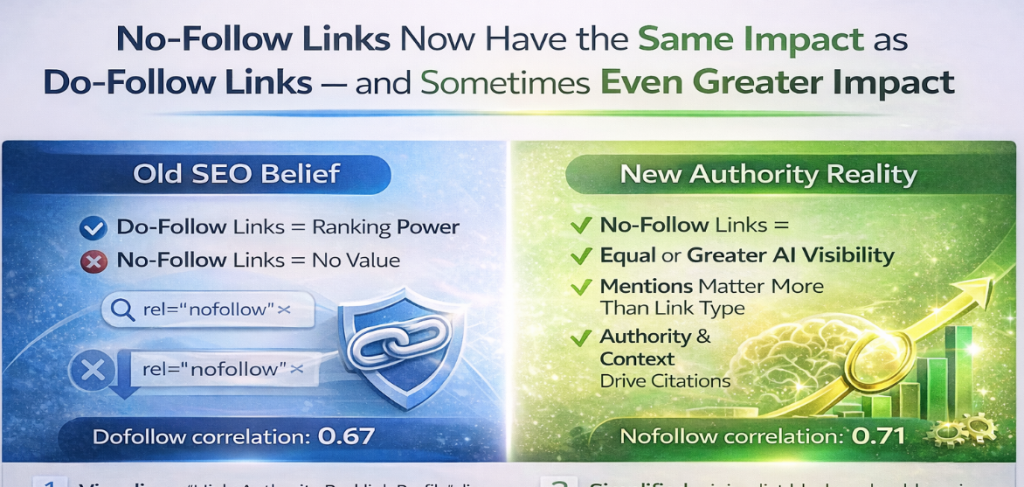
Here’s something that challenges conventional SEO wisdom: an independent study by Kevin Indig, analyzing over 35,000 data points across 1,000 domains, reveals that nofollow links now correlate as strongly—and often more strongly—with AI visibility than traditional dofollow links.
This finding is significant because it fundamentally changes how we should think about link building and authority.
What the Research Shows
AI treats links as credibility signals, not ranking votes : Unlike traditional SEO, which relied on PageRank-style link equity, AI systems evaluate links differently. They look for signals of trust and authority, regardless of the link attribute.
Mentions matter more than link type : Being referenced across authoritative sites—even without traditional “SEO juice”—increases AI visibility. The context and source matter more than whether the link passes PageRank.
Different AI models weigh links differently : ChatGPT and Gemini, in particular, showed stronger sensitivity to nofollow links than traditional follow links in the study.
Authority and diversity still matter : A wide range of credible referring domains amplifies AI trust, but only once a baseline authority threshold is reached.
What This Means in Practice
High-authority media mentions outperform traditional backlinks for AI visibility. References from trusted publications like USA Today, Business Insider, Associated Press, MSN, Bloomberg, and similar platforms act as strong credibility signals—even when those links are nofollow.
AI systems prioritize editorial mentions within authoritative content, not optimized anchor text or follow attributes. Being cited naturally in news articles, expert commentary, and data-driven features carries more weight than sidebar or footer links.
This represents a complete reversal of traditional link-building strategy. Instead of chasing dofollow links from any available source, the focus should be on earning mentions from genuinely authoritative platforms—regardless of link type.
Building authority across high-authority platforms requires strategic planning and execution. If you have questions about how this approach might work for your business, or if you’d like to explore having someone implement this strategy for you, send me a message. I work with local businesses to either guide the implementation process or handle the entire system—whatever makes sense for your situation.
The Compounding Challenges Facing Local Businesses
Let’s look at the specific obstacles local businesses face in this new environment:
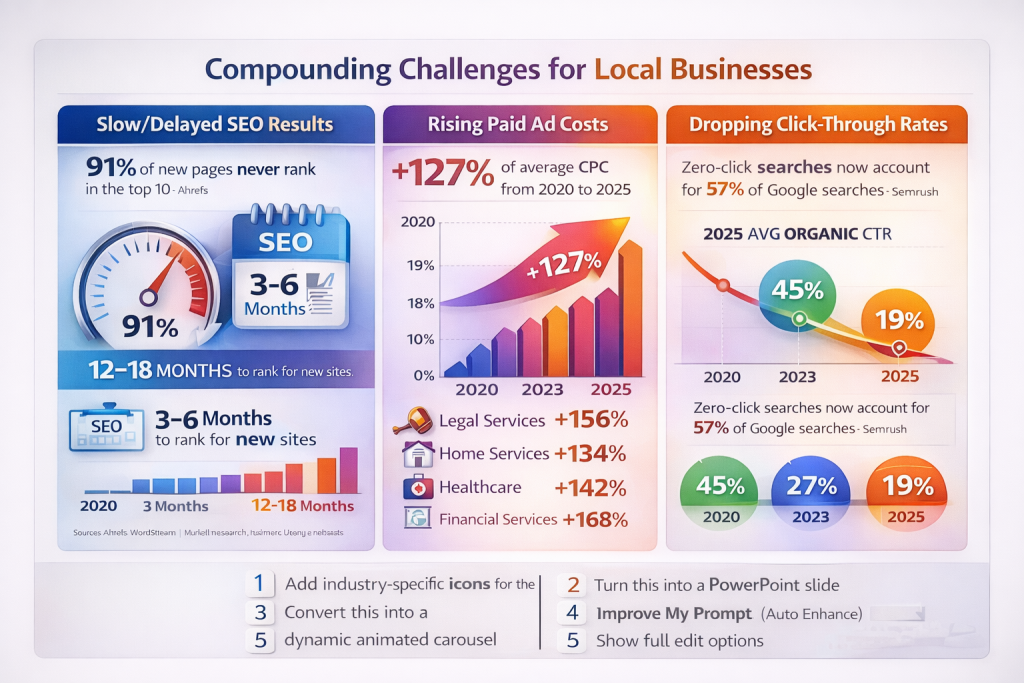
SEO Takes 6-12 Months (If It Works At All)
Google’s E-E-A-T algorithm prioritizes established authority. New sites or sites without brand recognition struggle to rank, regardless of content quality. You can do everything “right” from a technical SEO perspective and still see minimal results because your site lacks the authority signals Google now requires.
Paid Advertising Costs Are Crushing Small Budgets
Average cost-per-click has increased 127% since 2020. Small businesses simply can’t compete with larger corporations’ advertising budgets. What used to be an affordable way to generate leads has become prohibitively expensive for many local businesses.
Click-Through Rates Have Dropped to 19%
As Google’s AI-powered featured snippets and answer boxes dominate search results, fewer people actually click through to websites. Users get their answers directly from search results, meaning even if you rank well, you might not receive the traffic you expect.
AI Answers Bypass Websites Entirely
People increasingly get answers from AI platforms without visiting any website. Unless you’re cited by trusted sources that AI systems reference, these platforms won’t recommend your business—regardless of how good your website is.
Ad Costs Continue Rising Year After Year
Google and Facebook advertising costs have more than doubled since 2020, with increases exceeding 13% annually. For local businesses operating on tight margins, this makes paid advertising increasingly unsustainable as a primary lead generation strategy.
What’s Actually Working: The Authority-First Approach
Given these challenges, what should local businesses do? The answer lies in building authority through strategic visibility on platforms that Google and AI systems already trust.
Instead of fighting for rankings on your own low-authority website, the more effective approach is to get your expertise, your brand, and your business featured on high-authority platforms that already have Google’s and AI’s trust.
The Multi-Platform Authority Strategy
This approach involves establishing presence across numerous high-authority platforms simultaneously:
News and media sites : Getting featured in recognized publications that Google and AI platforms trust as credible sources
Video platforms : YouTube and Vimeo, where content can rank quickly and reach audiences who prefer video content
Podcast platforms : Spotify, Apple Podcasts, Google Podcasts, Stitcher, and others where engaged audiences consume long-form content
Visual content platforms : Pinterest, Flickr, and infographic sites where visual content can drive discovery
Presentation platforms : SlideShare, Flipsnack, and similar platforms where educational content performs well
Social media platforms : Facebook, Instagram, X (Twitter), and LinkedIn where content can reach and engage specific audiences
High-authority blogs : Established industry blogs and content platforms with existing domain authority
The key is not just being present on these platforms, but being present strategically and consistently.

Building authority across high-authority platforms requires strategic planning and execution. If you have questions about how this approach might work for your business, or if you’d like to explore having someone implement this strategy for you, send me a message. I work with local businesses to either guide the implementation process or handle the entire system—whatever makes sense for your situation.
Why This Approach Works
Instant credibility : When prospects research your business and find you featured on recognized brands and platforms, it immediately elevates your perceived authority.
Search engine domination : High-authority sites rank quickly—often within hours rather than months. Your content appears on page one because it’s published on domains Google already trusts.
AI citation authority : ChatGPT, Google AI, Perplexity, and similar platforms cite content from these trusted sources. When your expertise is featured there, AI systems reference you as an authoritative source.
Algorithm resilience : While competitors struggle with every algorithm change, content on established platforms maintains visibility because those platforms have enduring trust.
Premium positioning : Association with major brands and recognized platforms justifies higher prices and positions you as a go-to expert in your field.
The Content Multiplication Strategy
Here’s a practical approach that’s generating results: take a single topic and develop it into multiple formats, then distribute those formats across hundreds of high-authority platforms.

From one core topic, you can develop:
- Written articles for blogs and news sites
- Video content for YouTube and Vimeo
- Audio content for podcast platforms
- Infographics for visual platforms
- Slide presentations for educational platforms
- Social media content for engagement platforms
- Professional articles for LinkedIn
- Short-form content for Instagram and other visual platforms
Each format serves a different audience preference and platform algorithm. Someone who wouldn’t read a 2,000-word article might watch a 10-minute video on the same topic. Someone who wouldn’t watch a video might listen to a podcast during their commute.
By developing multiple formats from a single topic and distributing them across 300+ high-authority platforms, you accomplish several goals simultaneously:
Visibility Everywhere: Potential customers encounter your expertise across multiple platforms and formats, building familiarity and trust
Authority building: Each mention on a high-authority platform strengthens your overall authority profile
AI visibility: Multiple references across trusted sources increase the likelihood that AI platforms will cite your business
Search dominance: Content on high-authority platforms ranks quickly, occupying multiple positions in search results
Audience reach: Different formats and platforms reach different segments of your target audience
Building authority across high-authority platforms requires strategic planning and execution. If you have questions about how this approach might work for your business, or if you’d like to explore having someone implement this strategy for you, send me a message. I work with local businesses to either guide the implementation process or handle the entire system—whatever makes sense for your situation.
Brand Strength: The Ultimate Competitive Advantage
Have you ever wondered why some businesses can charge significantly more than their competitors? Or why certain businesses stay fully booked regardless of economic conditions?
The answer is brand strength and market authority.
These businesses have built brands so strong that they become the obvious choice in their market. They’re not competing on price because they’ve established themselves as the premium option. They’re not worried about algorithm changes because their authority transcends any single platform.
Building brand strength matters more now than ever because the market has fundamentally changed. The businesses that will thrive in this new environment are those that invest in authority building, not just optimization tactics.
The Five Ways Authority Building Grows Your Business
Instant reputation management : When prospects research your business, they find world-renowned brands and platforms featuring your expertise. This immediately positions you as a credible authority.

Search engine dominance : Content on high-authority sites ranks immediately, often appearing on page one within hours. You occupy multiple positions in search results without the 6-12 month wait traditional SEO requires.
AI answer authority : ChatGPT, Google AI, Perplexity, and similar platforms cite your content as the trusted source when people ask questions in your field. You become the recommended expert.
Competitive advantage : While competitors struggle with algorithm changes and rising ad costs, you’re leveraging platforms that algorithms already trust. Your visibility is more stable and sustainable.
Premium positioning : Association with major brands and recognized platforms justifies higher prices. You’re not just another local business—you’re an established authority featured by trusted sources.
Why Traditional SEO Without Authority Is Temporary at Best
You can spend months—and thousands of dollars—chasing rankings that vanish the moment Google updates its algorithm or you stop paying an agency.
Traditional SEO without trusted, high-authority sources behind it has limited lasting value in the current environment. Rankings fluctuate. Traffic drops. Conversions decline.
But authority built through recognition from credible sites compounds over time. Search engines and AI platforms continue to trust and reference that authority long after the initial work is done.
This is the fundamental difference between optimization tactics and authority building. One generates temporary visibility that requires constant maintenance. The other builds enduring recognition that strengthens over time.
Moving Forward: Assessing Your Current Position
If you’re evaluating your current marketing approach, consider these questions:
- When someone researches your business, do they find you mentioned on recognized, authoritative platforms?
- Are AI systems like ChatGPT and Perplexity citing your business when asked about your industry?
- Does your content appear on high-authority sites that rank quickly, or only on your own website?
- Is your visibility dependent on constant optimization and ad spend, or built on enduring authority?
- When prospects compare you to competitors, does your brand presence justify premium positioning?
Your answers to these questions reveal whether you’re building on a foundation of authority or relying on tactics that become less effective with each algorithm update.
The Path Forward
The businesses that will succeed in this new environment aren’t those with the most optimized websites or the biggest ad budgets. They’re the businesses that understand authority is the new currency of visibility.

Building that authority requires a different approach than traditional SEO. It requires strategic presence on platforms that Google and AI systems already trust. It requires consistent visibility across multiple formats and channels. It requires thinking beyond your own website to the broader digital ecosystem where your potential customers discover and evaluate businesses.
This shift isn’t temporary. It’s the new reality of digital marketing. The question is whether you’ll adapt your strategy to this reality or continue investing in approaches that deliver diminishing returns.
Building authority across high-authority platforms requires strategic planning and execution. If you have questions about how this approach might work for your business, or if you’d like to explore having someone implement this strategy for you, send me a message. I work with local businesses to either guide the implementation process or handle the entire system—whatever makes sense for your situation.